


1. Battery capacity (Ah)
Battery capacity is one of the important performance indicators to measure the performance of the battery, which indicates the amount of electricity discharged from the battery under certain conditions (discharge rate, temperature, termination voltage, etc.), usually in units of Ah. Taking a 48V, 100Ah cell as an example, it means that the capacity of the battery is 48V×100Ah=4800Wh, which is 4.8 degrees of electricity. Battery capacity is divided into actual capacity, theoretical capacity and rated capacity according to different conditions. The theoretical capacity refers to the capacity of the battery in the most ideal state; the rated capacity is the capacity indicated on the equipment that can work continuously for a long period of time under the rated working conditions; while the actual capacity will be affected by the temperature, humidity, charging and discharging multiplication rate and other factors, and generally speaking, the actual capacity is a little smaller than the rated capacity.

2. Rated voltage (V)
The voltage rating of an energy storage battery is its designed or nominal operating voltage, usually expressed in volts (V). An energy storage battery module consists of single cells connected in parallel and series. Parallel connection increases capacity with no change in voltage, and series connection multiplies voltage with no change in capacity. You will see in the battery PACK parameters similar to 1P24S parameters: S for series cells, P for parallel cells, 1P24S means: 24 series and 1 parallel - that is, the voltage of 3.2V cells, 24 series voltage doubling, the nominal voltage is 3.2 * 24 = 76.8V.

3. Charge/discharge multiplier (C)
Battery charge/discharge multiplier is a measure of how fast or slow a battery charges. This indicator affects the continuous current and peak current when the battery works, and its unit is generally C. Charge/discharge multiplier = charge/discharge current/rated capacity, for example: when a battery with a rated capacity of 200Ah is discharged with 100A, and all the capacity is discharged in 2 hours, the discharge multiplier is 0.5 C. Simply put, the higher the discharge current, the shorter the discharging time will be.
Usually when it comes to the size of an energy storage project, the maximum system power/system capacity is used to describe it, for example, 2.5MW/5MWh industrial/commercial energy storage project. 2.5MW is the maximum operating power of the system of the project, and 5MWh is the capacity of the system, if the power is discharged at 2.5MW, and it can be discharged in 2 hours, the discharge multiplier of the project will be 0.5C.
4. Depth of Discharge (DOD)
Depth of Discharge (DOD) is used to measure the percentage between the amount of battery discharge and the rated capacity of the battery. Starting from the upper limit voltage of the battery discharge, to the lower limit voltage discharge termination, all the discharged power is defined as 100% DOD. usually the deeper the depth of discharge, the shorter the cycle life of the battery. Batteries with less than 10% DOD may be over-discharged, which can lead to some irreversible chemical reactions seriously affecting the battery life. Therefore, in actual project operation, it is important to balance the need for battery runtime and cycle life to optimize the economics and reliability of the energy storage system.

5. State of charge (SOC)
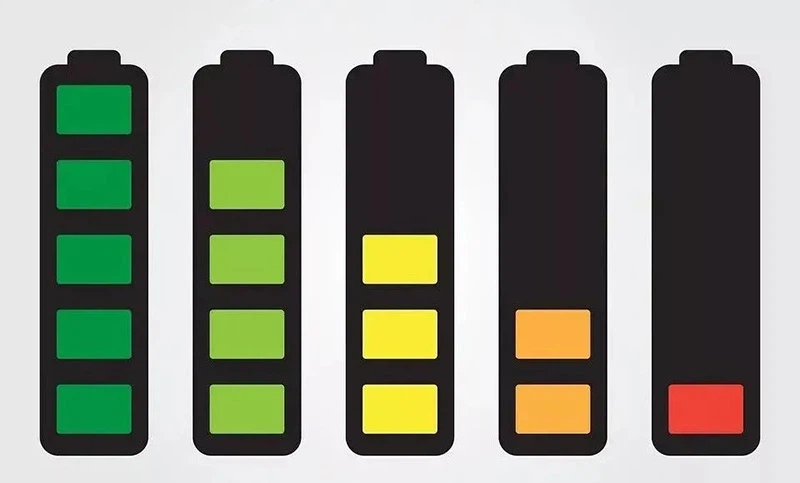
State of charge (SOC) is the percentage of the battery's remaining charge to the battery's rated capacity. It is used to reflect the remaining capacity of the battery and indicates the ability of the battery to continue working. In the case of fully discharged SOC is 0, fully charged SOC is 1, generally expressed in 0 to 100%
6. Battery State of Health (SOH)
State of Health (SOH) is simply the ratio of a battery's performance parameters to its nominal parameters after a period of use. According to IEEE (Institute of Electrical and Electronics Engineers) standards, a battery should be replaced when its capacity at full charge is less than 80% of its rated capacity after a period of use. By monitoring the SOH value, it is possible to predict when a battery will reach end-of-life and to maintain and manage it accordingly.
In order to better promote exchanges, Sencai Energy has set up a "direct mailbox for energy storage learning and exchange" vtntbj@163.com, aiming to provide a platform for industry insiders to communicate with each other, share energy storage dynamics, and search for high-quality resources, and to discuss the development path of the energy storage industry together.